Picture Book Literary Devices: 3 Not-So-Spooky Ghost Stories for Teaching Dramatic Irony
By Kelsey Buckley
When I was a sophomore in high school, my Language Arts teacher paired a picture book with our discussion of unreliable narrators. We gathered on the rug in the middle of the classroom while she read us The True Story of the 3 Little Pigs, written by Jon Scieszka and illustrated by Lane Smith. It’s a classic, laugh-out-loud book in which the Big Bad Wolf makes his case for being, well, not so big and bad. Our task was to point out the clues in both the text and illustrations that suggest that the Wolf’s story may not be entirely credible. It’s a lesson I never forgot! This blog series explores using picture books as examples of literary devices, and includes prompts to try these tools in student writing.
For October, I’m bringing you some not-so-spooky ghost stories. I love ghost stories (so much so that I wrote my Master’s thesis on American gothic fiction) and with Halloween approaching, I’ve been seeking them out in picture books too! Recently, three books caught my eye that I thought would be absolutely perfect examples of dramatic irony & “breaking the fourth wall.”
Dramatic irony is “a literary device that creates an incongruity between what the characters know and what the audience knows, thereby giving different and often contradictory meanings to the characters’ words and actions.” (Merriam Webster.)
Examples of dramatic irony range from the great Romeo & Juliet (we know Juliet is alive, and has taken a sleeping potion; Romeo does not) to the contemporary movie Frozen (we know Elsa is trying to protect her sister from her magical powers; Anna feels alone & ignored).
What could be more contradictory than a ghost, who is both there and not?! Each of these silly ghost also play with perspective, often “breaking the fourth wall” with the reader. They’re great books for showcasing the way a writer has the power to hide or reveal elements of a story in order to heighten the tension, get a laugh, or create surprise for the reader.
The House with Nobody in It, written & illustrated by Jon Klassen
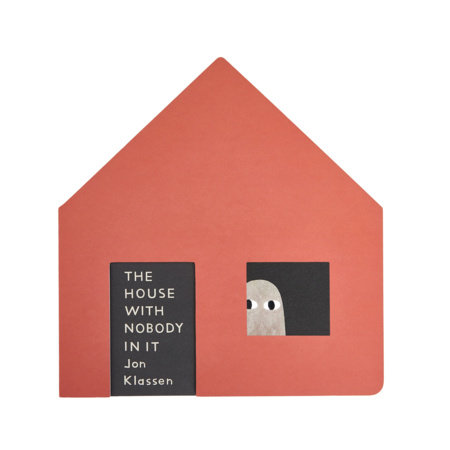 What a wonderfully weird board book! We enter a house…with nobody in it. Or so the narrator tells us. We move through each room of the house where the narrator points out various bits of furniture, ignoring the curious little ghost that trails along with us. We can clearly see that there is someone in the house, but the narrator seems entirely unaware, and continues touring us through the rooms. Look! we want to shout, There IS somebody in the house!
TRY IT: Practice creating your own dramatic irony by writing & drawing panels for a mini-graphic novel—what can the reader see that the character/narrator can’t? Something dangerous? Something silly?
Watch the Book Trailer from Candlewick Press
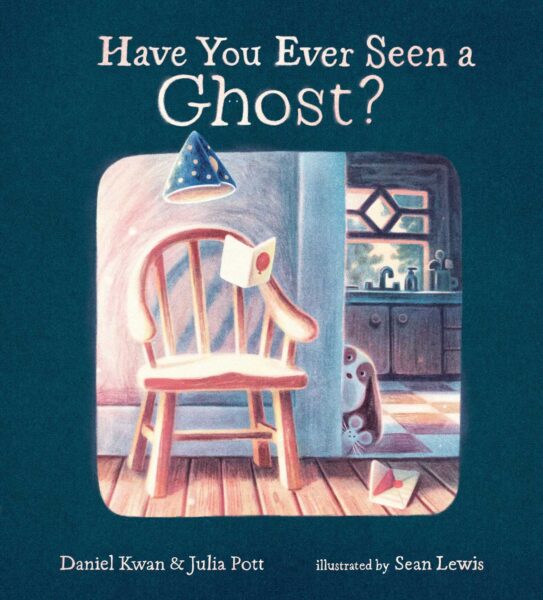
Have You Ever Seen a Ghost? written by Daniel Kwan & Julia Pott, illustrated by Sean Lewis
Our Director of School Programs, Alison, grabbed this book from the library for me to read—it’s such a sweet tale, it could hardly be called spooky. Think more along the lines of Casper the Friendly Ghost. Unlike The House with Nobody in It, this book opens with the line,”There is a ghost in this room,” which is helpful, because we can’t actually see Ghost. We can, however, see the party hat on their head. In this book, Ghost wants to go to a party hosted by their dear friend Martha, who they want to impress. Ghost is nervous. Martha is just the best. Will you help?
The illustrations in this book are cozy and playful. It’s silly and straight-up ironic—a book about a ghost we cannot see wants our opinions about how to dress for a party. There’s a great dramatic irony moment at the very end. (Ghost, we want to cry, there’s a poppy seed stuck in your teeth!)
TRY IT: Imagine a ghost that only you can see. What kind of props might they wear to give others a clue about who they are and how they feel? Write a scene where your ghost attends a party. How do they feel? What will they wear? Give the reader a piece of information that the ghost does not have.
Leo: A Ghost Story, written by Mac Barnett, illustrated by Christian Robinson
I have a fun story about this one. When IRW hosted Mac Barnett at the Jesup Memorial Library in Bar Harbor last spring, he was setting up slides on a large screen so that everyone in the audience would be able to see the book as he read it. There was a technical hiccup, and Mac joked, “Oh no! Close your eyes!” Once fixed, he began to read us Leo: A Ghost Story, which begins, “This is Leo. Most people can’t see him.” One little girl called out, “Because our eyes are closed!” The comedic timing was impeccable.
Anyway, the book goes on: “But you can. Leo is a ghost.” Of course, because we can see Leo, unlike the family that has moved into the home he haunts, we know Leo is a lovely, welcoming, friendly ghost. Silliness abounds in this book when Leo meets a friend who loves to play pretend and mistakes him for an imaginary friend.
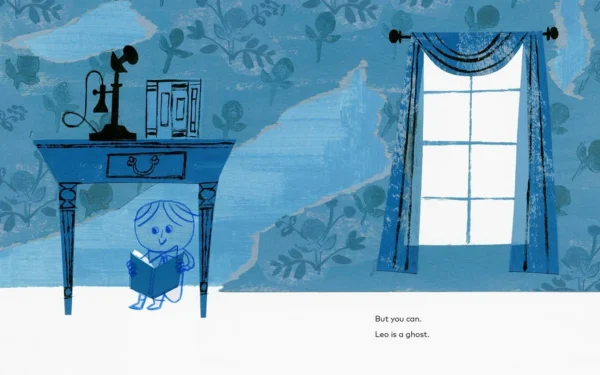
Like many of Mac Barnett’s books, Leo flips the script with delightful dramatic irony and the reader “in the know” all the while.
TRY IT: Write a story about mistaken identity! What kind of blunders might occur? Let the audience be “in the know” while it plays out.