Explore More Book Guide of the Month: Gather Round
Each month in 2026, we’ll feature one of IRW’s Explore More Book Guides (EMBGs). These freely available guides offer everything you need for a deep dive into a book we love. From author/illustrator biographical information to ideas for writing prompts, art projects, further research & text-to-text connections, our embgs have it all.
Our January Explore More Book Guide of the Month is the guide for Gather Round, written & illustrated by David Covell! We met David and brought him on tour with us to our partner schools for the first time in October 2025, but he’s no stranger to Maine—in fact, he’s a Mainer!
David grew up in Maine, on the coast and ’round a small lake in Rangeley. That’s where he ran wild. It was after one long day of building the family cabin that David made his first campfire, no doubt. With no electricity, no running water, and only a weekly trip to town, it was a perfect place for a kid to grow wild. —Read more about David here.
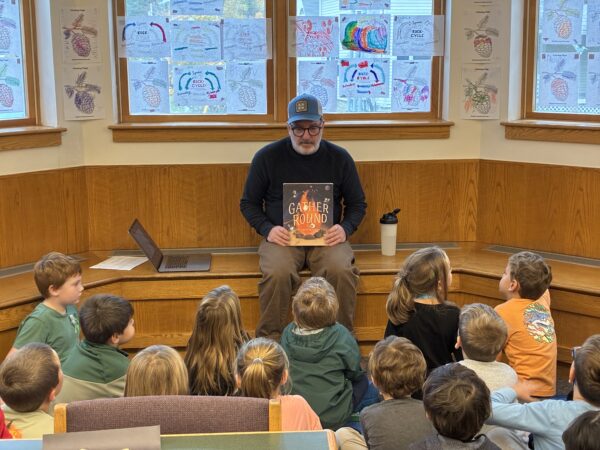
David gathers students ’round at Pemetic Elementary School last fall.
We chose Gather Round as our featured guide for January because it’s just the right story to warm you up during the deep freeze of a Maine winter: “In Gather Round, a girl and her father build a campfire together to keep the cold at bay. But as they welcome passing travelers—from musicians to animals—they create a community, fostered by a crackling fire and its comforting warmth.”
What will you find in this Guide?!
- Thoughtful, fun discussion questions…
- A Scavenger Hunt we developed just for this book, which requires careful observation as you read…
- A Venn Diagram graphic organizer for comparing the book cover & book jacket…
- Ideas for building a “fire” inside your classroom…
- A recipe for s’mores!
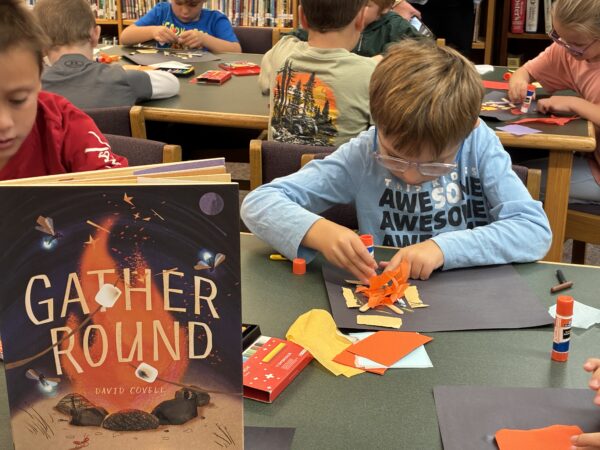
Students “build fires” with torn construction paper and glue sticks.
Standards Covered in this Guide
- SL.1. Prepare for and participate in conversations across a range of topics, types, and forums, building on others’ ideas and expressing their own.
- SL.2. Integrate and evaluate information presented in diverse media and formats, including point of view, reasoning, and use of evidence and rhetoric.
- SL.3 Present information and supporting evidence appropriate to task, purpose, and audience so listeners can follow the line of reasoning and incorporate multimedia when appropriate.
- R.4. Read various texts closely to determine what each text explicitly says and to make logical inferences; cite specific textual evidence to support conclusions drawn from the texts.
- R.5 Provide an accurate summary of various texts; determine the central idea(s) or theme(s) and analyze its development throughout each text.
- R.6. Analyze how and why individuals, events, and ideas develop and interact over the course of a text.
- R.8 Analyze the structure of various texts, including how the features and components relate to each other and the whole. R.9. Assess how perspective or purpose shapes the content and style of various texts.